Showing posts with label campfire. Show all posts

Saturday, August 31, 2019

Climbing Provo Peak 2019

Provo Peak (Oil on Panel)
This is a painting I made a few years ago Of Provo Peak, as seen from the valley near the boat harbor. Last Week, a friend of mine and I decided to hike Provo Peak, which rises 11,068 feet (about 3,374 meters) above sea level.

Provo Peak, Photographed from the Side of Lionshead Peak.
We started out in the afternoon, driving up Provo Canyon to Squaw Peak Road. There the driving became progressively worse the farther up the road we went. It seems that once past Rock Canyon Campground, the high mountain dirt road gets no maintenance. The road was full of rocks and deep ruts. A few places had holes as big as our car. It wasn't anything my 4Runner couldn't handle, we just had to drive slowly - often as slow as two miles an hour. It took us a couple hours to get from the beginning of the road to the trailhead.

Cascade Mountain, viewed from the Provo Peak trailhead.
Not long after beginning our climb, we found an unattended campfire. This is the second time in a week I've found campfires abandoned yet still burning in the mountains! And it's fire season. We didn't have enough water to put the fire out, so we dug up a lot of dirt and threw that on the fire until it stopped smoking.

Cascade Mountain, as seen from farther up the ridge.
The trail to the peak is not very good in some places. It's steep and full of loose rocks. Three times I left the trail and found my own way up the mountain for a while because the trail was so difficult and unsafe.

The higher we climbed, the hazier the weather became. I wonder if the haze was possibly from wildfires burning in other parts of the West. By the time we reached the 11,068 ft. high peak, the haze largely obscured the distant views we had hoped to see. The climb was still well worth it though! 

This was the fourth time I've climbed Provo Peak, and it's been a long time since the time before. I took a few photos from the top before we began our hike back down. The sun set before we were halfway down the mountainside. We made it to the trailhead, and the 4Runner, with the help of my flashlight. 

Hazy view of Cascade Mountain from the top of Provo Peak.

The view toward East Peak.

Looking southward from the peak along the main ridge.

The view ESE.

Looking down Slate Canyon to Utah Lake. 
The view from the top, toward Mt. Nebo.

Monday, June 17, 2019

A Couple of Early Spring Hikes


Technically, it wasn't early Spring when I took these photos, but high up in the mountains springtime lags behind the lower valley. Because of that, up high it looks like Spring is just getting started. Even higher it looks like winter still.


About a month ago I went for another hike up the same canyon I've been visiting off and on for a few months now. Less than a mile into the hike, I looked back and saw four Rocky Mountain bighorn sheep resting high on a ridge maybe three hundred or four hundred yards from me. The camera I carry on these hikes is a cheap little Casio, and it's rather limited in what it can do. I snapped a picture anyway. If you can't see the four bighorns on the skyline in the photo shown above, I'll include the next picture pointing them out.


The vegetation had greened up considerably since the last time I was in the canyon, though the trees had not leafed out completely.


Here's a section of thick stuff just off the trail about halfway to where the trail forks.


As I hike, I try to remember to look around - not just focus on whats ahead. That's how I got to see the bighorn sheep I mentioned earlier. There's other reasons to keep aware of the landscape behind and all around you. This is a view looking back down canyon to the cliffs and slopes I passed below earlier in the hike.


There's not much left of the avalanche tongue I had to hike over earlier this year. Small trees that were once mostly buried under several feet of snow are now beginning to sprout leaves.


The next picture is a view looking up canyon from the avalanche chute. If you look at the brush in the foreground you might notice that all those little trees are leaning dramatically down slope. These small trees are growing in the avalanche chute. The down-hill angle of the brush is caused by the force of avalanches that sweep down over them every winter, pressing them down. Some of the trees even seem to grow downhill, with only the very tips of the branches curving upwards. These trees might never reach beyond sapling size. From my observation, every tree in the avalanche chute that reaches a trunk diameter of two inches looses sufficient flexibility and is then snapped off by an avalanche.


Upon reaching the trail fork I head up the right hand trail to a meadow. I brought with me a little sheet metal fireplace. Disassembled, it stores completely flat, and is quick and easy to set up. I also brought a brand new 16 oz. stainless steel cup to cook in. 


The little sheet steel fireplace worked surprisingly well. Fed a steady supply of dry maple sticks it cooked my food quickly. Soon I had a hearty helping of oatmeal. The little plastic bottle next to the oatmeal contains honey, which was added to the oatmeal before dining.


Storm clouds began to move in during my break in the meadow. Soon the weather was threatening rain. After eating, I hiked a little farther up canyon, leaving the trail to explore around a little. My hike back down the canyon was in the rain. 


The following week I was back up the canyon. The vegetation was much greener than the week before.


Because of the way the wash meanders back and forth across the narrow canyon as it descends, the trail crosses the wash several times. The wash is usually dry, but on this day snowmelt from a heavy winter snowpack was pouring down the wash, making crossings challenging. Usually I was able to find a place where the stream was wider, shallower and had convenient stepping stones to cross on. A couple times I crossed the wash on fallen logs. A couple times I had to boulder hop above roaring chutes of water to get across. Once I thought I could make a place to cross by tossing a couple rocks for stepping stones into the stream. The rocks were each about a foot and a half in diameter. Shortly after tossing the rocks in, and checking their dubious stability with my hiking staff, I watched as the rapid current caught the hoped-for stepping stones and rolled them into deeper water. Time to find another place to cross.


A familiar view along the trail:


It was a little late in the day when I started the hike, so by the time I reached the meadow I sometimes cook meals at, the meadow was completely in shadow. That shadow was too dark for the camera when I photographed the mountain south of it. You'll just have to imagine a meadow at the bottom of this photo:


Returning to the trail fork I went up the left hand trail to a place I call "Moose Meadow." Instead of cooking a meal this time, I had just brought along some prepackaged snacks. Here they are, sitting on a large blue-grey limestone boulder full of brachiopod and crinoid fossils.


Since it was getting late, and the water crossings had been so tricky, I considered hiking out of the mountains a different way, one that would avoid the high Spring runoff. That would add a few miles to the return hike, some of which would be well after nightfall. After thinking it over, I returned the way I had come, once again successfully staying dry while crossing the stream eight times on my way back down the canyon.

Sunday, May 19, 2019

Last of Winter

This post squeezes four separate hikes, all in the same canyon, into one post. 

The snow is gone from the lower slopes and washes in the Wasatch Mountains, but quite a bit remains higher up. You might think that as winter changes to spring and moves on into summer that all would return to just the way things were the summer before. However, common to these mountains, a little bit of geological rearranging frequently occurs over the colder months. I've seen it as it has happened on occasion. For instance, this five foot wide boulder wasn't here in the trail last year:


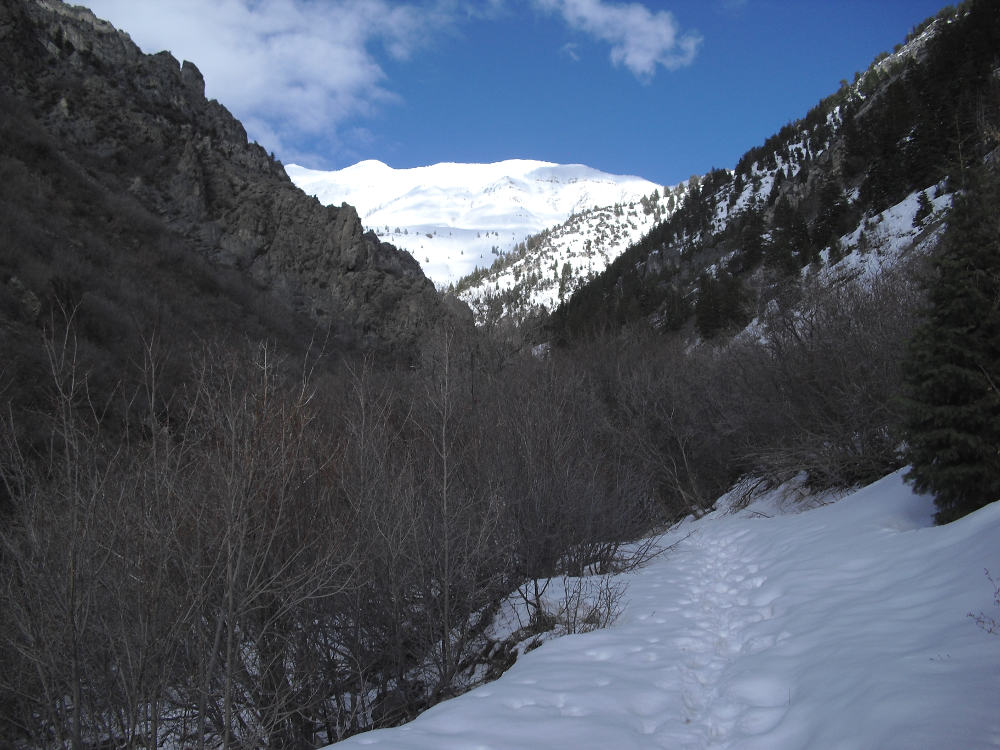
This hike took place April thirteenth of this year, in one of my favorite canyons in the Wasatch range. Higher up the trail, the hike eventually became over snow. That's the way hikes go this time of year. Passing clouds put me in shadow sometimes, but some part of the landscape was always sunlit.


Every once in a while I stop to take a selfie, enjoying the outdoors as always.


I hiked as far up the trail as I could before postholing in deep snow became a problem. Then it was time to return. 

In and out of sunlight and shadow, the section of trail shown below was illuminated as I returned down canyon.


___________________

A week later I was back up the same trail. The weather forecast that day called for a chance of rain. It was a chance I was willing to take. There was, of course, less snow on the trail. An avalanche tongue I've hiked across each time I've come up the canyon had shrunk considerably and was showing more of the debris it had brought down the mountainside earlier in the year.


Here's a view back down canyon from the receding avalanche tongue:


Dark storm clouds moved over the canyon, and an occasional clap of thunder echoed off of the canyon walls.


I didn't want to stay up that high if lightning became a concern, or if heavy rain became a possibility, turning the yet deep snow into a messy slush. As raindrops began, I donned my rain gear and headed back down the trail.


____________________

On a very pleasant day late in April I was back up the canyon. There was, of course, less snow this time. The avalanche tongue had shrunk even more since the last time I visited.


In fact, snow had receded off of most of the rocky trail that had been covered by the avalanche earlier in the year. Standing on the trail below the avalanche tongue, I observed how smaller trees which had survived the avalanche had become visible again as the snowpack had shrunken here. Judging from those small trees, and how they had revealed themselves incrementally over the past weeks, I was able to see that the trail where I was standing had been buried under about eight feet of snow when I was up here earlier this year.


There were still large patches of snow in the canyon, but it was such a pleasant day for a hike. I had packed a jacket in my day pack, but it was such a shirt sleeve kind of day, I never needed it.


One more look up canyon as I headed back down late in the day:


____________________

Early May saw me up the canyon once again. Down in the valley trees are well on their way to being fully leafed out. Not so up in the higher elevations, where trees are just beginning to bud. There was, however, much less snow than the week before. The avalanche tongue was growing thinner by the week.


The day had started out with very nice weather, but as it grew later in the day and I climbed higher, scattered storm cells began to form and pass over the mountains. None of the storm cells hit me directly, but I did get a little sprinkling of rain as one passed near. It wasn't enough to make me change my plans though. With less snow I was able to hike farther up the canyon, up into the elevation where aspen trees grow.


Not everything up here has the drab greyness of late winter. I took the right fork at the top of the trail and hiked to a nearby meadow. There I found large patches of bright yellow glacier lilies beginning to come into full bloom:


The meadow was mostly free of snow, though large patches still surrounded it.


This meadow is a good place to stop and rest. I planned to stay there a little while that day, so I built a fire of rocky mountain maple wood and cooked myself something to eat.


Apple cinnamon oatmeal, along with an outdoors-appropriate pot holder ;)


Here's the view I had to the south of the meadow:


There was plenty of moose sign in the area, but I saw no moose that day. To the north my view was of a mountain that rises nine thousand feet above sea level. As the sun moved toward the western horizon, shadows cast by mountains west of me began to creep up the sides of mountains to my east.


After dinner (which besides oatmeal, also included some whole grain fig bars), I cleaned the pan with snow and heaped a pile of snow on the dying fire to make sure it was out. Then I hiked the short distance back to the fork in the trail, and went up the left fork to a meadow I call "Moose Meadow". From there I had a great view of a mountain to the east, one that rises over eleven thousand feet high.


As I began my hike back down, I met a man who had decided, just on the spur of the moment, to hike up the canyon that day. He told me he was sixty seven years old, had always lived in the area, and was recovering from months of cancer treatment. We hiked back down together, telling each other our experiences in the canyon, and about animals we've met there. We saw a couple mule deer as we descended the trail. I dearly hope that when I'm 67, I'm still hiking in the mountains. Is 77 too much to ask?